Different machines, particular needs
The term special-purpose machinery covers a very wide family of equipment: forestry machines, mobile cranes and truck-mounted cranes, mobile elevating work platforms, drilling and piling rigs, road sweepers, refuse compactors, snow ploughs and specialised agricultural equipment. For all these machines, industrial lubricants must cope with irregular duty cycles, often sensitive environments and temperatures that vary widely through the year.
Compared with conventional construction equipment, many of these machines alternate periods of intensive work with long idle periods, operate in forests, urban areas or near waterways, and are fitted with complex hydraulic systems, often with many actuators and accumulators. Lubrication must take all these aspects into account.
Hydraulics and environmentally acceptable fluids
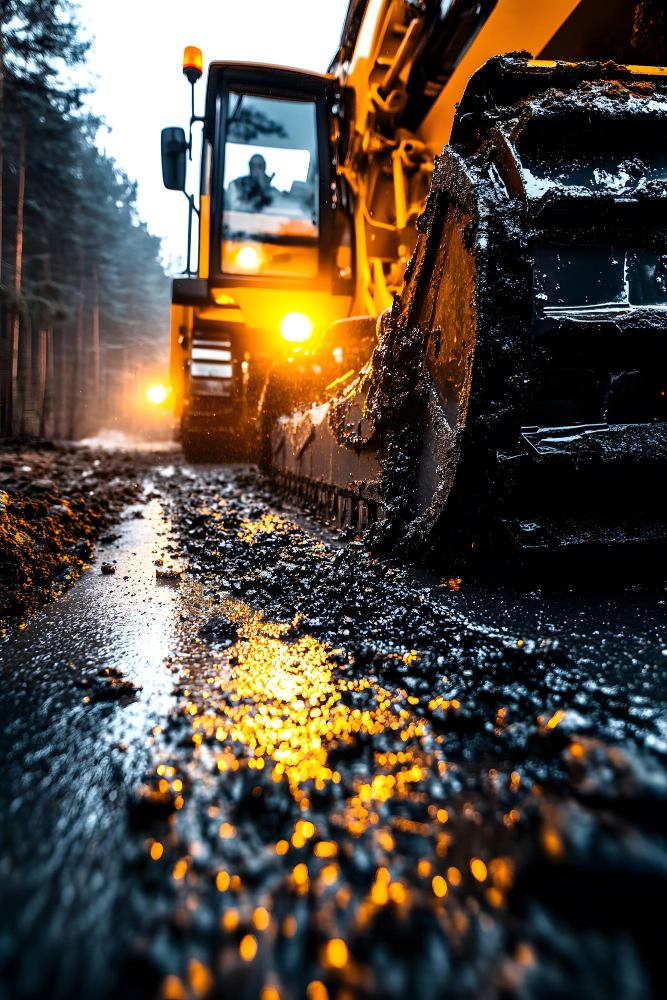
The hydraulic system is the most important system on almost all special-purpose machines. In forestry, in work near rivers and lakes and in many protected areas, a burst hose can release dozens of litres of oil into the soil or water. For this reason these applications often use environmentally acceptable hydraulic fluids, classified into families according to their chemical base:
- Triglyceride-based Derived from vegetable oils, with good biodegradability but limited stability at high temperatures and against oxidation.
- Synthetic ester-based They offer a good balance between performance, service life and biodegradability.
- Polyglycol-based They have particular characteristics and are not miscible with mineral oils.
- Based on polyalphaolefins and related hydrocarbons They combine good technical performance with biodegradability requirements.
Switching from a mineral oil to a biodegradable fluid requires a changeover and flushing procedure, to minimise the amount of previous oil left in the circuit, and a check of compatibility with seals and hoses. It is a job to be planned with the machine manufacturer and the fluid supplier.
Forestry machines
Felling and forwarding machines work on difficult terrain, with highly stressed hydraulic systems and harvester heads that use saw chains lubricated with oil. Bar and chain lubrication is a total-loss system: the oil is consumed and dispersed during work. For this reason biodegradable chain oils are used in many settings, with good tackiness so that they are not thrown off by the chain speed.
Cranes, platforms and lifting machines
- Wire ropes They require specific lubricants that penetrate between the strands and protect against internal corrosion.
- Slewing rings They must be greased regularly, rotating the superstructure to distribute the grease.
- Winches and gearboxes They use gear oils suited to high loads.
- Telescopic booms The sliding pads require lubricants suitable for sliding under load.
Mobile elevating work platforms, which may stand idle for weeks, need hydraulic oils with good low-temperature properties and careful checks before returning to service, to verify levels, leaks and the absence of condensation.
Drilling and foundations
Drilling rigs work with high loads, vibration and the presence of mud and water. Rotary heads and gearboxes require high-performance gear oils, while the threads of drill rods are protected with specific compounds that make make-up and break-out easier and reduce the risk of galling.
Extreme temperatures and long idle periods
Snow ploughs and machines working at high altitude must start and operate at very low temperatures: they need lubricants with a low pour point and a high viscosity index. At the other extreme, sweepers and compactors working in summer operate in hot, dusty environments, where oxidation resistance and good filtration are essential. For seasonal machines it is useful to check the lubricants before lay-up and when returning to work, because condensation and ageing continue even when the machine is idle.
Centralised lubrication
Many special-purpose machines have dozens of greasing points, some of them hard to reach. Automatic centralised lubrication systems distribute grease regularly during operation, reducing maintenance time and the risk of missed points. They must still be checked periodically: reservoir, lines and distributors must be intact, and the grease used must be suitable for the pumping system, especially at low temperatures.
Safety
Residual energy and suspended loads
Hydraulic systems can retain pressure even with the engine off, for example because of accumulators: before opening a circuit, residual energy must be released according to the manufacturer's instructions. Never work under suspended loads or booms that are not mechanically secured. Remember too that a biodegradable fluid is not harmless: leaks must still be contained and collected.