Why use a grease instead of an oil
Grease is a lubricant that stays where it is put. While an oil tends to flow away and has to be contained or circulated, a grease adheres to surfaces, forms a barrier against dust and water and keeps lubricating even without a circulation system. Among industrial lubricants it is the most common choice for bearings, joints, slideways and open mechanisms.
Greases are preferred when it is not practical to maintain an oil bath or circulation, when the component must stay protected for long periods between interventions, when a sealing effect against contaminants is needed, or when the lubricant must not drip onto products or floors. Oil remains preferable when a lot of heat has to be removed, at the highest speeds, or when the lubricant must be filtered continuously.
Composition of a grease
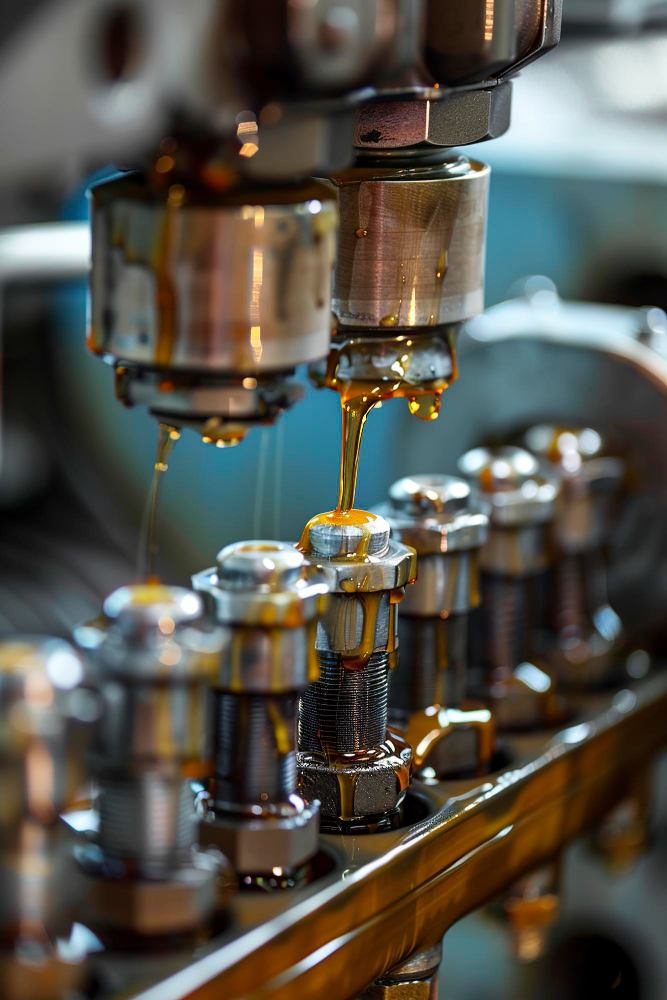
A grease is made of three elements. The base oil, mineral or synthetic, makes up most of the product and is what actually provides lubrication. The thickener forms a structure that holds the oil, rather like a sponge, and releases it gradually under the effect of movement and temperature. Additives add properties such as protection against wear and extreme pressure, resistance to oxidation and protection against corrosion. Some greases also contain solid lubricants, useful in slow, heavily loaded movements.
For this reason, when choosing a grease, the viscosity of the base oil is as important as the thickener: a more viscous base oil suits high loads and low speeds, while a thinner base oil is preferred for high speeds.
Thickener families
- Simple soaps Lithium, calcium and sodium soaps. Lithium soaps were for a long time the most widely used for general purposes; calcium soaps have good water resistance but temperature limits; sodium soaps have poor water resistance.
- Complex soaps Such as lithium complex, aluminium complex and calcium complex: they generally allow higher operating temperatures than simple soaps.
- Calcium sulphonate complex Known for excellent water resistance, corrosion protection and good behaviour under load.
- Polyurea A non-soap thickener, often used for bearings that need a long service life, for example in electric motors.
- Organophilic clays Inorganic thickeners that do not melt like soaps: suitable for high temperatures, provided the base oil is chosen accordingly.
Consistency and classification
The consistency of a grease indicates how soft or hard it is. It is measured with a penetration test, in which a standard cone sinks into the grease after it has been mechanically worked: the deeper the cone penetrates, the softer the grease. On the basis of the result, greases are classified into consistency grades ranging from 000, almost fluid, to 6, very hard.
- Grades 000, 00 and 0 Semi-fluid greases, used in centralised lubrication systems and some enclosed gearboxes.
- Grades 1 and 2 The most widely used: grade 2 is the most common for bearings, while grade 1 is often preferred at low temperatures and for pumpability.
- Grades 3 and above Firmer greases, used in particular applications, for example where greater stability under vibration is needed or in some large bearings.
The properties to read on the data sheet
- Dropping point The temperature at which the grease, in a standard test, becomes fluid enough to drip. It does not coincide with the maximum service temperature, which is always considerably lower.
- Operating temperature range The figure to consider when selecting, as stated by the producer.
- Water resistance The ability not to be washed out or emulsified.
- Mechanical stability The ability to keep its consistency under prolonged stress.
- Oil separation Slight separation is normal and necessary for lubrication; excessive separation indicates instability.
- Load-carrying and anti-corrosion properties Essential for joints, open gears and damp environments.
Compatibility between greases
Greases with different thickeners are not always compatible with each other. Mixing them can cause excessive softening, with the grease leaking out, or hardening that prevents proper lubrication. When changing product it is good practice to remove as much of the previous grease as possible, or purge it with the new product until it has been completely replaced, and to check the compatibility information provided by the producers.
Relubrication: neither too much nor too little
The amount and frequency of relubrication depend on the type and size of the bearing, speed, temperature and the presence of contaminants. The most common mistakes are two opposites:
- Too little grease The film breaks down and wear and noise increase.
- Too much grease In high-speed bearings, excess grease is continuously churned, raises the temperature and can damage the seals.
Know your grease gun
Every grease gun delivers a precise amount with each stroke. Knowing it, even with a simple weighing, makes it possible to turn the manufacturers' recommendations into an exact number of strokes, instead of relying on habit.
Greases for special applications
There are greases for very high or very low temperatures, greases for incidental food contact registered for use in the food industry, silicone greases compatible with many plastics and rubbers, open gear greases and anti-seize pastes for threaded connections. The choice must always be based on the actual application and the machine manufacturer's instructions.
Storage and handling
Greases should be kept in closed containers, protected from excessive heat, dust and water, using older stock first and respecting the shelf life stated by the producer. Tools and pumps dedicated to each product, kept clean and closed, prevent contamination and mix-ups.
High pressure
Manual and pneumatic grease guns reach very high pressures. A blocked grease nipple must not be forced and the jet must never be pointed at hands or the body: grease injected under the skin causes serious injuries that need immediate medical attention, even if the wound looks small.